Eclipse Questions and Answers: A Comprehensive Guide

Discover essential eclipse information, from types and safety to viewing tips and frequently asked questions, all compiled for easy understanding and learning!
What is a Solar Eclipse?
A solar eclipse is a breathtaking celestial event where the Moon passes between the Sun and Earth, casting a shadow upon our planet. This alignment isn’t constant; it requires a precise configuration of these three bodies. During an eclipse, the Moon blocks all or part of the Sun’s light, creating a temporary darkness.
Understanding this phenomenon involves recognizing the Sun’s immense size and the Moon’s relative distance. While the Sun is vastly larger, the Moon appears similar in size from Earth due to its closer proximity. This unique circumstance allows for the spectacular blocking of sunlight.
Different types of solar eclipses exist, each offering a unique viewing experience, as we will explore further in this guide.
Types of Solar Eclipses
Solar eclipses aren’t all the same; they manifest in four distinct forms. Total eclipses are the most dramatic, with the Sun completely obscured by the Moon, revealing the corona. Partial eclipses occur when only a portion of the Sun is covered.
Annular eclipses happen when the Moon is farthest from Earth, appearing smaller and leaving a bright ring of sunlight visible around it – a “ring of fire.” Finally, hybrid eclipses are rare, transitioning between total and annular depending on the observer’s location.
Each type presents a different visual spectacle and requires varying safety precautions when viewing. Understanding these differences enhances the eclipse-watching experience.
Total Solar Eclipse
A total solar eclipse is arguably the most breathtaking celestial event. It occurs when the Moon passes directly between the Sun and Earth, completely blocking the Sun’s face. This creates an eerie darkness, resembling twilight, even during the day.

During totality, the Sun’s corona – its outer atmosphere – becomes visible, appearing as a pearly white halo around the black disk of the Moon. Temperatures can drop noticeably, and animals may exhibit unusual behavior.
Witnessing a total solar eclipse is a rare and unforgettable experience, demanding proper eye protection during the partial phases before and after totality.
Partial Solar Eclipse
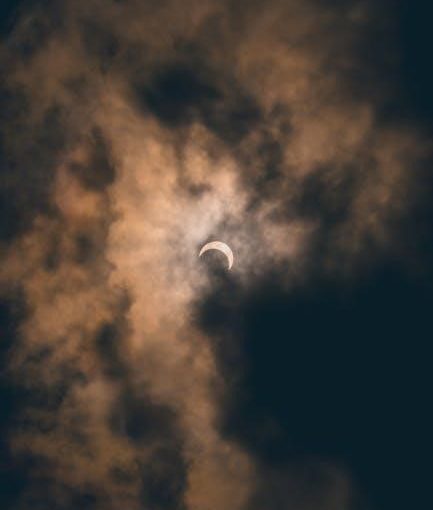
A partial solar eclipse happens when the Moon passes between the Sun and Earth, but they aren’t perfectly aligned. Only a portion of the Sun appears to be covered by the Moon, creating a crescent shape.

Unlike a total eclipse, the sky doesn’t darken significantly during a partial eclipse, and the sunlight remains quite bright. It’s crucial to always use proper eye protection, such as eclipse glasses, throughout the entire event.
Partial eclipses are far more common than total eclipses and are visible from a much wider area, offering a safe and accessible way to experience a solar eclipse.
Annular Solar Eclipse
An annular solar eclipse occurs when the Moon passes between the Sun and Earth, but the Moon is at its farthest point from Earth. This greater distance makes the Moon appear smaller than the Sun.
As a result, the Moon doesn’t completely cover the Sun, leaving a bright ring, or “annulus,” of sunlight visible around the Moon’s silhouette. This creates a spectacular “ring of fire” effect.
Similar to partial eclipses, proper eye protection is essential throughout the entire event, as looking directly at the Sun, even during an annular eclipse, can cause serious eye damage. These are also more common than total eclipses.
Hybrid Solar Eclipse
A hybrid eclipse is the rarest type, a fascinating combination of total and annular eclipses. It begins as an annular eclipse, transitioning to a total eclipse, and then back to annular as the shadow path moves across Earth’s surface.
This unusual shift happens because of the curvature of the Earth. The Moon’s apparent size changes slightly during the eclipse, allowing for both a ring of fire and a complete solar disk coverage.
Observers along different parts of the eclipse path will experience either a total or annular eclipse, depending on their location relative to the shadow’s changing geometry. These events are complex and require precise calculations to predict.
Why Do Eclipses Occur?

Solar eclipses happen due to a remarkable cosmic alignment. The Moon passes between the Sun and Earth, casting a shadow upon our planet. This can only occur during a New Moon phase, when the Moon is positioned in line with the Sun from our perspective.
However, perfect alignment is rare. The Moon’s orbit is tilted about five degrees relative to Earth’s orbit around the Sun. This tilt means the Moon usually passes above or below the Sun in the sky.
When the Moon, Sun, and Earth align perfectly on the line of nodes – the points where the Moon’s orbit intersects Earth’s – an eclipse becomes possible.
The Role of the Moon’s Orbit
The Moon’s elliptical orbit significantly influences eclipse occurrences. Its distance from Earth varies, impacting the apparent size of the Moon in the sky. A closer Moon can completely block the Sun, resulting in a total solar eclipse.
Conversely, when the Moon is farther away, it appears smaller and may not fully cover the Sun, leading to an annular eclipse – a “ring of fire” effect. The Moon’s orbital plane is tilted five degrees relative to Earth’s orbital plane.
This tilt means eclipses don’t happen every New Moon. They occur only when the Moon crosses the line of nodes, where its orbit intersects Earth’s.
Safety Precautions for Viewing a Solar Eclipse
Directly viewing the Sun, even during a partial eclipse, can cause severe and permanent eye damage. Never look directly at the Sun without proper eye protection. Specialized eclipse glasses, complying with the ISO 12312-2 international safety standard, are crucial.
Ensure your eclipse glasses are undamaged – no scratches or holes. Regular sunglasses are insufficient. Safe indirect viewing methods include pinhole projectors, which project an image of the Sun onto a surface.
Telescopes and binoculars require special solar filters. Never use these without a certified solar filter, as concentrated sunlight will cause immediate damage.
Importance of Eclipse Glasses
Eclipse glasses are paramount for safe solar viewing, shielding your eyes from the Sun’s intense rays. Genuine eclipse glasses meet the ISO 12312-2 international safety standard, filtering out 99.999% of visible light and infrared/ultraviolet radiation.
Counterfeit glasses offer no protection and can cause serious, irreversible eye damage – even blindness. Always purchase from reputable vendors listed by recognized organizations. Inspect glasses for scratches or damage before use; discard if compromised.
Remember, regular sunglasses, even very dark ones, are insufficient. Proper eclipse glasses are the only safe way to directly observe a partial or annular eclipse.
Safe Indirect Viewing Methods
Directly viewing the sun, even briefly, can cause severe eye damage. Fortunately, several safe, indirect methods exist for experiencing an eclipse. A pinhole projector creates a small image of the sun on a surface, allowing safe observation.
Alternatively, use binoculars or a telescope with a certified solar filter securely attached to the front. Never look through these devices without proper filtration. Another option is to watch a live stream from NASA or other reputable sources.
These methods allow you to witness the eclipse’s progression without risking your eyesight, offering a fascinating and secure viewing experience.
What is the Solar Corona?
The solar corona is the outermost part of the Sun’s atmosphere, extending millions of kilometers into space. Usually invisible due to the Sun’s brightness, it becomes visible during a total solar eclipse when the moon blocks the photosphere.
It appears as a pearly white halo around the darkened sun, exhibiting intricate structures like streamers and loops. Composed of extremely hot plasma, the corona’s temperature reaches millions of degrees Celsius, far exceeding the Sun’s surface.
Studying the corona provides crucial insights into the Sun’s magnetic field and solar activity, impacting space weather and Earth’s environment.
Visibility of the Solar Corona During Totality
During the brief period of totality in a total solar eclipse, the Sun’s brilliant photosphere is completely obscured by the Moon, revealing the normally hidden solar corona. This ethereal glow appears as delicate, shimmering streamers and loops extending outwards.
The corona’s visibility depends on the Sun’s activity cycle; during solar maximum, it’s more extensive and complex. Observing the corona requires dark skies and clear weather, offering a breathtaking spectacle;
It’s a unique opportunity for both professional astronomers and amateur enthusiasts to study this outer layer of the Sun’s atmosphere without specialized equipment, though proper eye protection is crucial before and after totality.
Duration of a Total Solar Eclipse
The maximum duration of totality in a total solar eclipse is approximately 7 minutes and 31 seconds, though this is exceptionally rare. Most totalities last only a few minutes, averaging around 2 to 3 minutes.
Several factors influence the length of totality, including the Earth-Moon distance and the Sun’s position in its orbit. When the Moon is closer to Earth (perigee), and the Sun is farther away (aphelion), totality is longer.
The longest possible duration occurs when the eclipse happens near the Earth’s equator, maximizing the path length and totality time, offering an extended viewing opportunity.
Factors Affecting Eclipse Duration
Eclipse duration is significantly impacted by the Earth-Moon distance; a closer Moon results in a longer totality. The Sun’s position within its yearly orbit also plays a role, with a more distant Sun contributing to extended darkness.
The point on Earth where the eclipse occurs relative to the equator matters too. Eclipses near the equator tend to have longer durations due to the Earth’s curvature and the shadow’s path.
Furthermore, the speed at which the Moon’s shadow travels across the Earth influences totality length; slower speeds equate to longer viewing times, creating a more spectacular celestial event.
Frequency of Solar Eclipses
Solar eclipses aren’t as rare as one might think! On average, a solar eclipse happens somewhere on Earth approximately every 18 months. However, a total solar eclipse at any specific location is much rarer, occurring only once every 360 to 410 years.
This discrepancy arises because the shadow path of totality is relatively narrow. While multiple eclipses occur regularly, witnessing a total eclipse from a fixed point is a unique and infrequent event.
Partial eclipses are far more common, visible over a much wider area, offering a more frequent opportunity to observe some degree of solar obscuration.
Eclipse Paths and Locations
The path of a solar eclipse is determined by the complex interplay of the Sun, Moon, and Earth’s movements. Predicting these paths requires precise astronomical calculations, accounting for orbital mechanics and Earth’s rotation.
Eclipse paths aren’t straight lines; they’re typically curved, tracing a narrow band across the Earth’s surface. Locations within this path experience the most dramatic effects, like totality. Outside this path, observers see partial eclipses.
Modern technology and data allow scientists to accurately forecast eclipse paths years in advance, enabling enthusiasts to plan viewing trips to optimal locations along the path of totality.
Predicting Eclipse Paths

Accurate eclipse path prediction relies on sophisticated astronomical calculations, utilizing the known orbital elements of the Earth and Moon. These elements describe their movements through space over time.
Scientists employ complex algorithms and computer models to determine where the Moon’s shadow will fall on Earth’s surface. These calculations account for variations in Earth’s rotation and the Moon’s elliptical orbit.
Organizations like NASA publish detailed eclipse maps and predictions, providing observers with precise information about the timing and location of eclipses. These resources are invaluable for planning viewing experiences.
Common Eclipse Questions
Many wonder if eclipses can be predicted – the answer is a resounding yes! Astronomers accurately forecast eclipses centuries in advance using celestial mechanics. Another frequent question concerns animal behavior during an eclipse; animals often exhibit nighttime behaviors, confused by the sudden darkness.
Regarding human health, beyond the critical need for eye protection, eclipses aren’t generally harmful. However, the psychological impact of witnessing such a rare event can be profound. Understanding these common inquiries enhances the eclipse experience.
Can Eclipses Be Predicted?
Absolutely! Eclipses aren’t random occurrences; they are predictable celestial events governed by precise gravitational interactions. Astronomers utilize sophisticated calculations based on the orbits of the Earth, Moon, and Sun to forecast eclipses with remarkable accuracy, sometimes centuries in advance.
These predictions consider variations in orbital speeds and paths. Historical records demonstrate ancient civilizations also possessed knowledge of eclipse cycles. Modern technology refines these predictions, providing detailed information about eclipse paths, duration, and visibility for specific locations.
What Happens to Animals During an Eclipse?
Interestingly, animal behavior during an eclipse is often observed to change. As daylight diminishes unexpectedly, some animals exhibit nocturnal behaviors – birds may cease singing and attempt to roost, while other creatures may become quiet and seek shelter.
This is thought to be a response to the sudden darkness, triggering instincts associated with nighttime. However, reactions vary significantly between species and even individual animals. Some may show no noticeable change, while others display confusion or anxiety. It’s a fascinating area of ongoing observation and study!
Is an Eclipse Harmful to Humans? (Beyond Eye Safety)
Generally, a solar eclipse isn’t directly harmful to humans beyond the well-documented risk of eye damage from looking directly at the sun. However, some historical beliefs suggested eclipses could cause illness or misfortune, stemming from ancient superstitions.
Modern science dismisses these claims, finding no evidence of negative health effects beyond the need for proper eye protection. The psychological impact, such as anxiety in those sensitive to dramatic events, is possible but not a widespread concern. Prioritizing safe viewing practices remains the key precaution.
Resources for Further Learning
For comprehensive and up-to-date information on solar eclipses, NASA’s Eclipse Website is an invaluable resource, offering detailed explanations, maps, and safety guidelines. Space.com’s Eclipse Coverage provides accessible articles, news, and stunning imagery related to upcoming and past eclipses.
Additionally, exploring educational materials and frequently asked questions (FAQs) available online can deepen your understanding. These platforms offer a wealth of knowledge, from the science behind eclipses to practical tips for safe viewing and photography, ensuring a well-informed eclipse experience.
NASA Eclipse Website
NASA’s dedicated eclipse website serves as a premier resource for all things eclipse-related. It provides meticulously curated data, including eclipse maps detailing paths of totality and partiality, precise timing information for various locations, and safety guidelines crucial for protecting your eyes during viewing.
Furthermore, the site features educational resources explaining the science behind eclipses, historical records of past events, and stunning imagery captured by NASA missions. It’s an invaluable tool for both seasoned eclipse chasers and those experiencing their first solar eclipse, offering a wealth of knowledge and practical information.
Space.com Eclipse Coverage
Space.com delivers comprehensive and up-to-date coverage of solar eclipses, offering news articles, stunning photographs, and live streams of events. Their reporting includes expert analysis of eclipse phenomena, detailed guides on how to safely view an eclipse, and information on upcoming eclipse paths and visibility.
Additionally, Space.com provides accessible explanations of the science behind eclipses, answering frequently asked questions and debunking common myths. They often feature interviews with astronomers and eclipse experts, offering unique insights and perspectives. It’s a fantastic resource for staying informed and engaged with the world of eclipses.
Eclipse Photography Tips
Capturing a solar eclipse requires careful planning and the right equipment. Utilize a solar filter for your camera lens to protect it during partial phases. A tripod is essential for sharp images, especially with long exposures. Experiment with different exposure settings to achieve optimal brightness and detail.
During totality, remove the solar filter to reveal the corona. Focus manually for clarity. Consider bracketing exposures to ensure you capture the full dynamic range. Photograph the “diamond ring” effect – a stunning visual phenomenon. Post-processing can enhance your images, but avoid over-editing.
Understanding the “Diamond Ring” Effect
The “diamond ring” effect is a breathtaking phenomenon occurring just before and after totality during a total solar eclipse. As the last sliver of sunlight shines through valleys on the Moon’s limb, it creates a brilliant, sparkling point resembling a diamond set against a dark ring – the solar corona.
This effect is caused by diffraction of sunlight through the lunar topography. It’s a fleeting moment, lasting only seconds, making it a prized capture for eclipse photographers. Observing this spectacle safely requires proper solar filters until totality begins, then their removal.
The NOCACHE Option in Database Systems
The ‘NOCACHE’ option, within database systems, dictates how blocks retrieved during a full table scan are managed in the buffer cache. Specifically, it places these blocks at the Least Recently Used (LRU) end of the cache. This strategy prevents frequently accessed blocks from being prematurely evicted by the full scan process.
Essentially, NOCACHE prioritizes maintaining the cache’s effectiveness for regular queries. It’s particularly useful when performing large scans that might otherwise disrupt normal database operations. Middleware like ‘nocache’ in npm disables caching, ensuring endpoints aren’t cached, and the Cache-Control header’s ‘no-cache’ directive achieves a similar result.
NoCache Middleware and HTTP Caching
NoCache middleware functions by effectively disabling HTTP caching mechanisms for specified endpoints. This ensures that each request retrieves fresh data, bypassing any cached versions. Utilizing packages like the ‘nocache’ npm module provides a straightforward method for implementing this functionality within Node.js applications.
HTTP caching, governed by headers like ‘Cache-Control’, normally stores responses to reduce server load and improve performance. However, scenarios demanding real-time data necessitate bypassing the cache. The ‘no-cache’ directive within the Cache-Control header instructs intermediaries to revalidate with the origin server before serving cached content.
Cache-Control Header Directives
Cache-Control headers are pivotal in managing HTTP caching behavior, dictating how browsers and intermediaries handle responses. The ‘no-cache’ directive doesn’t prevent caching entirely; it mandates revalidation with the origin server before utilizing a cached response. Conversely, ‘no-store’ absolutely prohibits caching, ensuring data isn’t saved at any point.

Other directives include ‘public’, allowing caching by anyone, and ‘private’, restricting caching to the end-user’s browser. ‘max-age’ specifies the cache’s validity duration, while ‘s-maxage’ overrides this for shared caches. Understanding these directives is crucial for optimizing performance and ensuring data freshness.
Nocache Package in npm
The ‘nocache’ package, available via npm, serves as middleware designed to disable caching mechanisms within Node.js applications. Installation is straightforward: simply run ‘npm i nocache’. Its primary function is to destroy caching, ensuring each request receives a fresh response from the server, bypassing any potential cached versions.
Version 4.0.0 represents the latest release, dropping support for older Node versions (14 & 15), requiring Node 16 or higher. Previous versions included the Pragma header, now removed. This package is a valuable tool for scenarios demanding real-time data or preventing stale content delivery.
Eclipse Fundamentals Concept Questions
These concept questions, designed for assessing fundamental understanding, utilize a selected response format. They specifically test knowledge related to the geometrical aspects of eclipses, probing comprehension of the alignment of the Sun, Moon, and Earth. The questions aim to evaluate a learner’s grasp of core principles governing eclipse occurrences.
Such assessments are valuable tools for educators and students alike, providing a quick and efficient method for gauging understanding of eclipse mechanics. They focus on foundational concepts, ensuring a solid base for further exploration of this fascinating astronomical phenomenon. Expect questions testing basic eclipse knowledge.